Bottlenose Whale (Hyperoodon ampullatus (Forster, 1770)) |
|
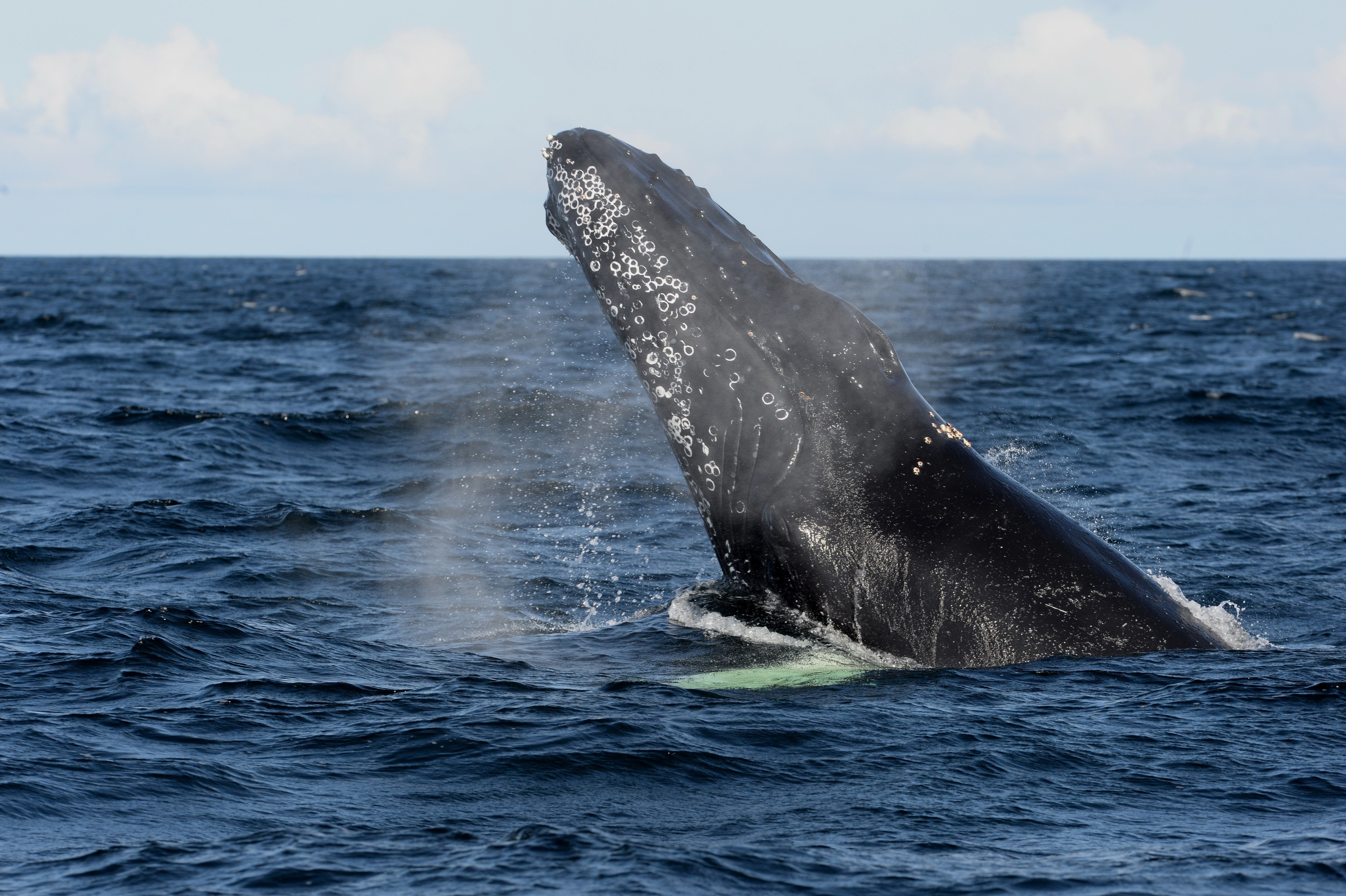
The dorsal fin is of moderate size, located 2/3 of the way down the back towards the tail, sub-falcate to triangular in shape and may have a pointed tip. The blowhole, which is wide compared to other cetaceans, is crescent or slit-shaped with the horns turned forward. A V-shaped pair of short grooves is found on the throat (a characteristic feature of beaked whales), with the wide end of the V orientated towards the tail. The flippers are small and taper to a point. The flukes are broad, do not have a median notch, and have concave trailing edges. Young bottlenose whales are dark, black to brown in colour on the dorsal surface, and greyish white ventrally. Adults are dark dorsally and lighter on the ventral surface. White or yellowish white spots often appear on the sides or belly, and seem to increase with age. There is often a white band on the neck in older females. Older males are easily recognised by the white forehead, which always has well-defined borders and may extend as an irregular patch as far back as the eyes. The forehead and beak is generally somewhat lighter in colour than the rest of the body. Occasionally old males become entirely yellow-white. Photographs of the distinctive marks on the dorsal fin, melon and 'saddle' area near the dorsal fin, may be used to identify individuals at sea. Two species of bottlenose whales have been described, Hyperoodon ampullatus in the North Atlantic and H. planifrons in the Southern Hemisphere.
Distribution & Habitat: Habitat: Northern bottlenose whales are found in cold temperate to arctic waters, often along boundaries between cold polar currents and warmer Atlantic currents. They seem to favour deep waters (more than 1,000m in depth) over submarine canyons and along the continental shelf edge. Although rarely caught in the North Sea, stranded bottlenose whales are reported from the coasts of Belgium, Denmark, France and UK, and as far south as Spain. In the western Atlantic there are two centres of distribution: 'The Gully', an area north of Sable Island, Nova Scotia, and the Davis Strait off northern Labrador. The migrations of northern bottlenose whales are poorly documented, but it appears that they migrate northwards to sub-arctic regions in spring and southwards in the early autumn. Whaling records show bottlenose whales off the Faroe Islands in March, and between Iceland and Jan Mayen at the end of April through May and the beginning of June. The number of bottlenose whales stranded on the British coast seems to increase in the autumn, possibly due to a southward migration at this time of the year, and most sightings from UK waters occur at this time. Some bottlenose whales, however, are present year-round in a small area known as the Gully off Nova Scotia, Canada, where they may be isolated from other populations. Natural History & Ecology: Adult bottlenose whales measure from 6.5 to 10 m in length and weigh from 6 to 8 tonnes. Females attain sexual maturity at a mean length of about 6.9 m and 8 to 12 years of age, and males at 7.5 m and about 11 years of age. The gestation period is estimated to be about 12 months, with mating and births peaking in April. Lactation is estimated to last at least 1 year, although observations of female whales accompanied simultaneously by newborn calves and juvenile animals, suggest that lactation may be prolonged. Squid form the bulk of the diet of the northern bottlenose whale, and the squid Gonatus fabricii may be a particularly important prey species. Fish and invertebrates (such as deep sea prawns) are also eaten, and herring has been found in large amounts in the stomachs of some individuals. These beaked whales probably often feed near the sea bed, since benthic animals such as starfish and sea cucumbers have also been found in the stomachs of some animals, as well as stones, shells, clay and bits of wood. It has been suggested that bottlenose whales may sometimes use the beak as a plough in the mud when foraging. Social behaviour: Northern bottlenose whales are usually found in groups of 1 to 4 animals; it is rare to see larger groups, although several groups may be seen in the vicinity of one another. There are, however, historic reports of migrating bottlenose whales in herds of several hundreds.
Recent studies of the resident bottlenose whales of the Gully, off Nova Scotia, have divided groups into 3 categories: male groups (containing 1 to 5 mature or maturing males); female groups (containing 1 to 9 females and immatures); and mixed groups (containing 2 to 8 females and immatures and 1 to 3 mature or maturing males, usually with more females and calves than males). Some pairs of whales have been found to show long-term associations over periods of at least a year. Consistent associations have also been observed among females and among males respectively, but no evidence of such relationships among mature whales of the opposite sex has been found. Care giving (epimeletic) behaviour is well known for the bottlenose whale. |
Back to Fact Files
Back to Seismic Work
Back to Taxonomy
Back to Strandings
Key
Our research programme would not be able continue if it were not for the
support
and encouragement given by our Supporters.
Please pay them a visit.
Return to the TOP of the Page
HOMEPAGE | ABOUT
US | RESEARCH | RESCUE
| EDUCATION | HOW
YOU CAN HELP | SPONSORS | LINKS
| SITEMAP