|
Order:
Cetacea
Suborder: Odontoceti; Family:
Phocoenidae
Identification:
Measuring just 1.5 to 1.9 m in length and weighing between 45 and
85 kg, the harbour porpoise is the smallest cetacean in British waters.
It has a short, rotund body with a blunt snout and no obvious beak.
The dorsal fin is small and triangular in shape, and there is a slight
dorsal ridge extending back from the dorsal fin to the tail flukes.
Colouration is variable, but harbour porpoise typically have a dark
grey head and jaws, pale throat and ventral surface, and a dark back
and flanks. In adults, there is often a striking grey line from just
below the eyes to the anterior insertion of the flipper. Flippers,
tail flukes, and dorsal fins are all dark grey to blackish in colour.
Harbour
porpoises are usually seen in small groups of less than ten animals,
although larger aggregations of upto 50 individuals are sometimes
seen. The swimming motion of the harbour porpoise is
usually inconspicuous, involving surfacing with a rolling motion,
although the animals occasionally surface with a vigorous vertical
motion causing a splash. The characteristic unobtrusive respiration
sequence and small size makes it difficult to observe these animals
in all but the calmest of sea conditions. Moreover, the species is
notoriously shy and retiring and generally avoids approaching boats.
Distribution & Habitat:
The harbour porpoise is found in cold temperate and sub-arctic waters
of the Northern Hemisphere, commonly inhabiting shallow coastal bays,
estuaries and tidal channels of the Atlantic coast of Europe, east
and west coasts of North America and the Pacific coast of Asia. Currently,
the species is abundant in the central and northern North Sea and
on the continental shelf west of the British Isles. However, they
have now virtually disappeared from the Baltic, and the winter migration
which they once undertook from the Baltic into the North Sea has ceased.
They
are still regularly seen in the Danish Wadden Sea and particularly
in the northern North Sea, west to the Orkney and Shetland Islands,
in the North-west of Scotland, western Ireland and West Wales.
Most sightings occur on the continental shelf, and thus frequently
within 10 km of the coast and generally in water less than 100 m deep.
Although the species does not seem to make long migrations, harbour
porpoises undertake seasonal movements related to food availability:
generally inshore in summer and offshore in winter, but sometimes
also north in summer and south in winter. In northern Scotland and
in Danish coastal waters, however, harbour porpoises are present year-round.
In the Black Sea, North Atlantic and North Pacific populations have
become semi-isolated and have been proposed as separate sub-species.
Natural
History & Ecology: Harbour porpoises reach sexual maturity
at an age of 3 to 6 years, and at body lengths of about 1.35 m in
males and 1.45 m in females. Mating occurs in summer and the gestation
period is one year or less. Subsequently, births are generally in
summer, and have been recorded between May and August (with a strong
peak in June) around the British Isles. The period of lactation is
uncertain, but is thought to occur for around 8 months as females
calve every 1 to 2 years.
These porpoises appear to feed upon a variety of fish
and cephalopods; the diet varying with location and availability of
prey items. Prey species include herring, mackerel, sprat, pollack,
hake, sardines and sandeel, squid, octopus, crustaceans, molluscs
and polychaete worms.
Studies of harbour porpoises in Shetland, Scotland and
west Wales have indicated that foraging is closely related to tidal
cycle. It is suggested that pelagic shoaling fish (such as sandeels,
whiting and herring) become concentrated in the tidal race, and the
channels are used by the porpoises to herd and catch this prey. 
The species usually hunts singly or in small groups, but they may
form loose aggregations if there is a large amount of food, despite
still tending to feed semi-independently. Because of its large surface
area to mass ratio, the tiny harbour porpoise must eat up to 10 %
of its body weight per day to survive in the cold temperate waters
of the North Sea.
Social behaviour: Large
aggregations of harbour porpoises are usually related to feeding or
seasonal movements, and often comprise a number of small cohesive
pods spread over a wide area. There may be some sexual segregation,
possibly of females travelling singly with their young while males
associate in schools. Immature animals of both sexes may also form
separate groups as in bottlenose dolphins.

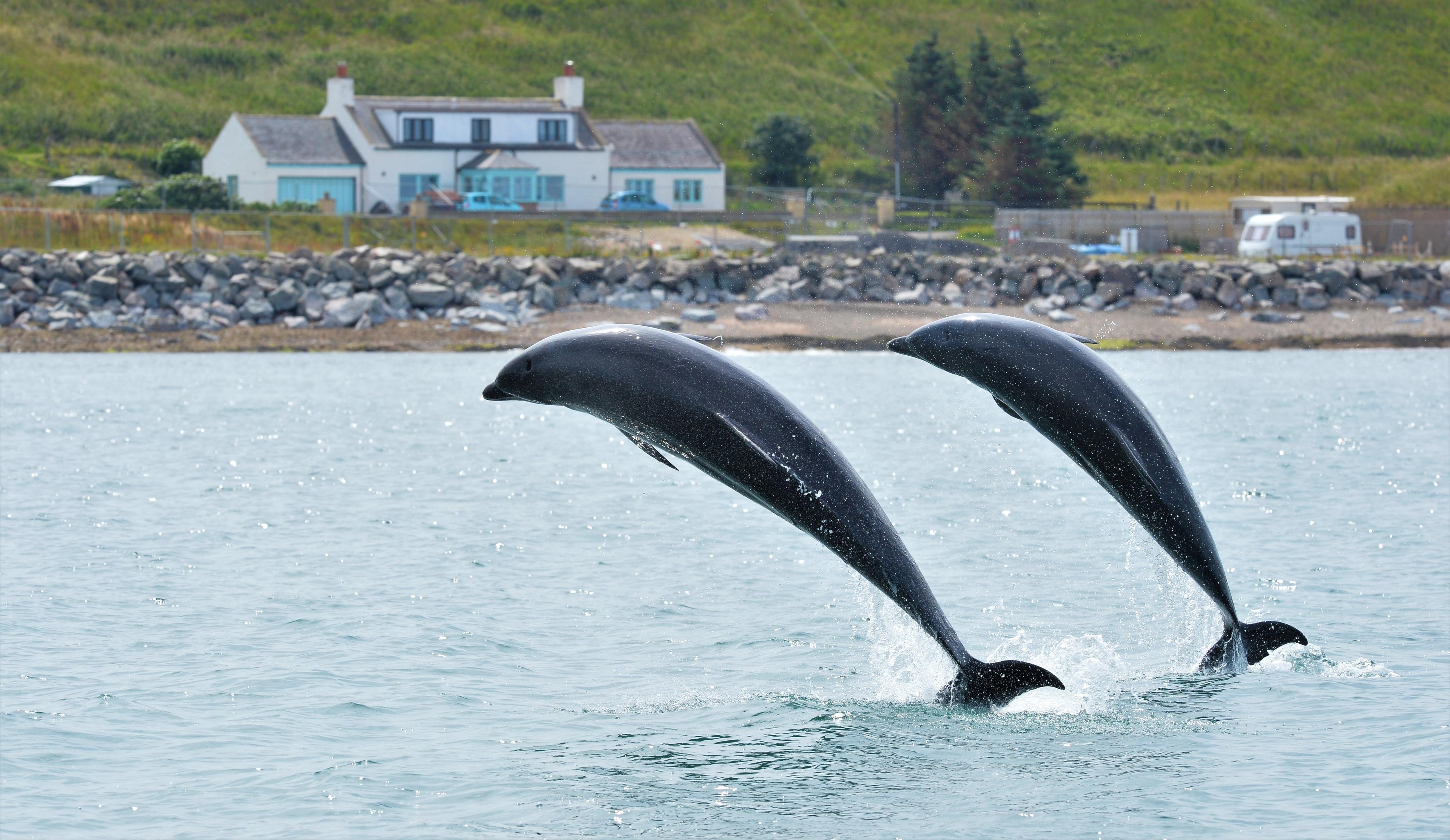
Play
is not frequently observed, but there are documented cases of porpoises
picking up objects such as starfish and seaweed and carrying them
in mid-water for hours at a time, balancing them on their flukes or
flippers. They occasionally breach, possibly during intense foraging
periods and in a social context, and have been observed to leap over
each other and perform tail slaps when socialising. Feeding schools
are often associated with seabirds.
|