Bottlenose dolphin studies in the Outer Southern Moray Firth
---------------------------------------------------


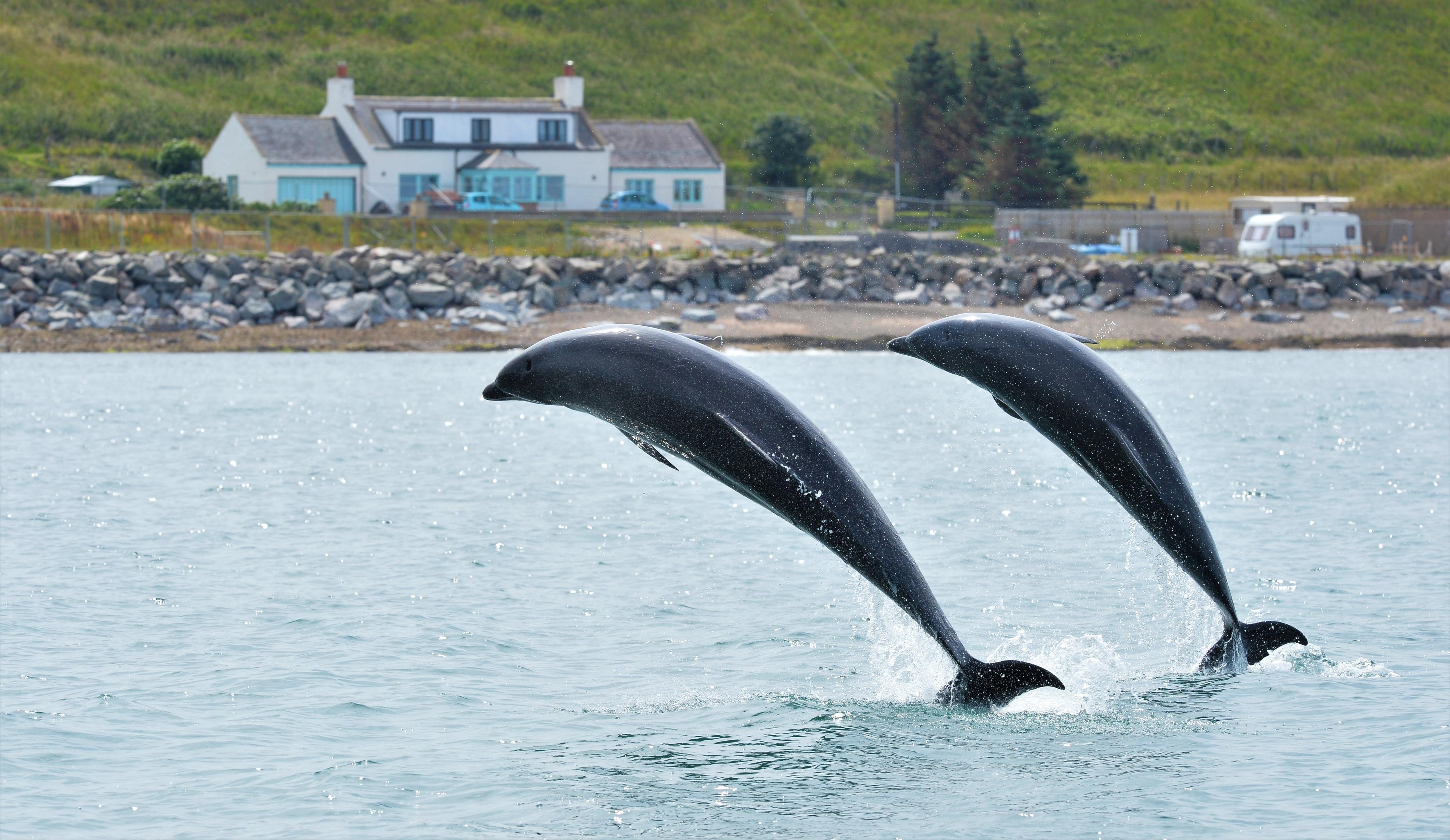
The Moray Firth's bottlenose dolphin population is perhaps the most northerly, resident colony of bottlenose dolphins in British waters. Here, the dolphins are a very familiar sight, delighting anglers, pleasure boaters and land lovers all along the coastline. They may be seen throughout the Moray Firth and south to the Tay estuary and Firth of Forth, but the deep, narrow channels of the inner Moray Firth and the bays and river mouths of the outer firth's southern coastline appear to be used most intensively by the animals.

Here at the Cetacean Research & Rescue Unit, we are learning about the lives of these dolphins by what is termed "benign research" - by watching, photographing and describing the animals, without catching or bothering them. The southern coastline (Map) of the outer Moray Firth, between Lossiemouth and Fraserburgh appears to be an important area for the animals which, in contrast to locations within the inner Moray Firth, from Cromarty to Inverness, has received little research effort to date. Dorsal fin bearing multiple scarring used in identification. Photo by Kevin Robinson / CRRUOne very important tool that helps our studies of these animals tremendously, is that many bottlenose dolphins have nicks and scars in the thin, easily-tattered, trailing edge of their dorsal, or top, fin. Since no two scar patterns are exactly alike, individual animals can be reliably distinguished from one another by photographing their dorsal fins, which are as individual to the trained eye as faces are to humans (see CRRU ID catalogue). Some dolphins have obvious lesions and other characteristic markings on their dorsal fins and bodies that may also further aid in identification. Repeated sightings of known individuals provide us with much information about the animals such as movement patterns, site preferences and group composition, for example. While one of us can visually tell more than 50 dolphins apart by sight in the field, extensive photography, sometimes with more than 100 photos taken of a group of only 6 to 10 dolphins, helps to verify who is present or not on a particular day. Using this photographic identification technique, more than 150 different dolphins have been identified using the coastline since our studies began in 1997. Of course, not all these dolphins were using the area at the same time. Many were simply passing through or just visiting the bay for several days (transient animals), but some individuals are known to use this area on a very regular basis.

Female bottlenose with young calf in tow. Photo by Kevin Robinson / CRRUFrom studies of the species in other parts of the world, it seems that the residency of some bottlenose dolphins is seasonal, probably to best take advantage of the occurrence and abundance of the various fish species on which they feed. In the Moray Firth, there are certainly fewer sightings of dolphins during winter months, and this may be related to the movements of fish out of the Firth in response to declining water temperatures. Whatever the cause of these movements, seasonal changes in the distribution of the dolphins have clear implications for management proposals. For example, the peak number of dolphins using the Moray Firth appears to coincide with a peak in the number of births suggesting that the Firth is an important breeding or nursery area for the animals. If this is so, then the Moray Firth will contain the most vulnerable fraction of the population during the summer period.

Photo by Kevin Robinson / CRRUBehavioural studies of the bottlenose dolphins also form an important component of our research work. Broadly speaking, dolphin behaviour can be classified into the main categories of travelling (termed transiting), foraging or feeding, socialising, resting and milling. These animals display an amazing diversity of feeding patterns as they capture fish and invertebrates. They may feed alone, feed co-operatively in a group, use natural and man-made barriers to corral fish, or feed in association with fishing boats. Co-operative feeding is commonly observed in the open waters of the southern Moray Firth, where large groups of dolphins (15-35+ animals) can often be seen herding fish.

Photo by Joe Stevens / CRRUAt present, it is estimated there are between 90 and 170 bottlenose dolphins in the Moray Firth, but it could be well into the next century before we can determine whether or not the population is actually increasing or decreasing. This is because bottlenose dolphins are long-lived mammals that have low reproductive rates. Females reach sexual maturity at 7-12 years of age, after which calves are produced singly only every 2-3 years in a 40-50 year life span. Consequently, clear assessments of the status of this population and the factors that will affect the success of these animals require long term and on-going studies. Today we no longer have the luxury of studying these creatures just to learn more about them. Now we must learn more about them simply to protect them. And ultimately, the more we know and understand about the private lives of these enigmatic creatures, the more we can do to protect them and the sensitive marine environment in which they live.

To learn more about the biology and natural history of the bottlenose dolphin click HERE

To find out how you can help support the CRRU's vital research work, take a look at the "How You Can Help" pages on this website by clicking HERE.


Click HERE to return to the Research page

Our research programme would not be able continue if it were not for the support and encouragement given
by our Supporters. Please pay them a visit.

Return to the TOP of the Page


HOMEPAGE | ABOUT US | RESEARCH | RESCUE | EDUCATION | HOW YOU CAN HELP | SPONSORS | LINKS | SITEMAP